Choosing the right Paper Bowl supplier is not simply a price comparison. It is a quality, safety, and supply-chain decision. A bowl may look acceptable on a sample table, yet soften under hot soup within minutes. That small failure can damage customer trust and increase waste.
Industry research supports this broader view. Smithers’ report, The Future of Global Paper Packaging to 2028, highlights continuing demand for fiber-based packaging and stronger performance expectations. Grand View Research also identifies foodservice packaging as a market shaped by convenience, hygiene, sustainability, and regulatory pressure. These trends make supplier verification more important than attractive quotations alone. A reliable supplier should provide clear material specifications, food-contact documentation, production records, and consistent batch testing.
Ask practical questions. What paper grade is used? Is the bowl suitable for oily or acidic foods? How long does it retain strength after filling? Can the factory provide migration test results and recent quality certificates? Request physical samples, then test them with real products at serving temperature. The rim should remain firm. The base should not leak. Printing should stay clean after handling.
Look beyond the first order. Review production capacity, lead times, mold control, complaint procedures, and shipment protection. Supplier audits and traceability records can reveal weaknesses that brochures rarely show. No supplier is perfect. Even experienced buyers sometimes prioritize low cost too early. That is worth reconsidering.
The best partnership balances performance, compliance, delivery reliability, and total cost. A trustworthy Paper Bowl supplier does not merely promise quality. It demonstrates it repeatedly, with evidence.
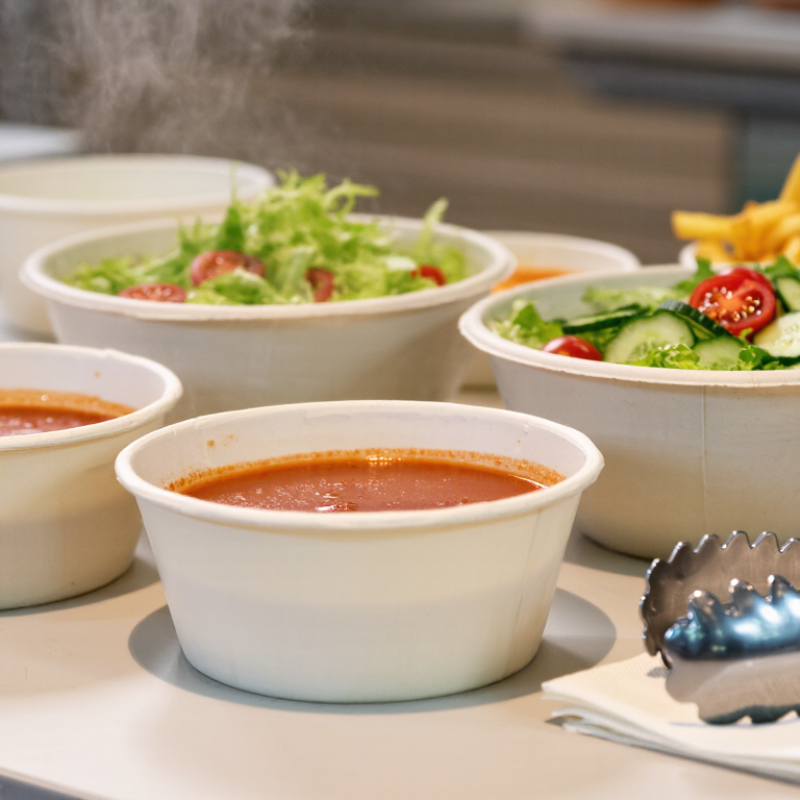
Choosing the right paper bowl supplier starts with understanding your actual use. Before requesting prices, describe the food, serving temperature, portion size, and service environment. A bowl for hot soup needs stronger moisture resistance than one used for dry snacks. A takeaway bowl may also require a secure lid and stable stacking.
Measure the capacity you need. A 12-ounce bowl may suit desserts but feel too small for a full meal. Check the rim diameter, base stability, wall thickness, and storage space. I once focused only on appearance and ignored stacking efficiency. That mistake created wasted shelf space and slower packing. Real use reveals hidden problems.
Write down your requirements clearly. Include material preferences, printing needs, quantity, delivery schedule, and budget limits. Ask potential suppliers for samples and technical specifications. Test each bowl with hot food for at least thirty minutes. Check for softening, leaks, unpleasant odors, and lid movement. It helps to test filled bowls during transport, not only on a clean table. That detail is easy to miss.
Confirm that the supplier can provide suitable food-contact documentation for your market. Request consistent sample quality across multiple batches. A reliable supplier should answer specific questions without vague promises. If your needs are uncertain, begin with a small trial order. Record what worked, what failed, and what still needs improvement. Even a careful plan can miss one practical detail.

01 Choosing the Right Material
Choosing a paper bowl supplier requires more than comparing prices. Material affects strength, moisture resistance, and food safety. Virgin paper usually offers a cleaner surface and better stiffness. Recycled fiber can support sustainability goals, but its quality may vary. Ask for food-contact certificates, fiber sources, coating details, and migration-test results. The Food and Agriculture Organization reported global paper and paperboard production above 400 million tonnes in recent statistics, so “paper” alone says very little about quality.
Size & Performance Size should match the meal, not just the catalog. A 12-ounce bowl may suit soup, while a 16-ounce bowl needs stronger walls and a secure lid. Request samples filled with hot soup, oily noodles, or chilled fruit. Check leakage after 30 minutes. Design also affects performance. A rolled rim improves grip, while a wider base reduces tipping. It looks simple.
Customization & Verification Customization can include color, logo placement, embossing, rim shape, and lid compatibility. Ask about printing inks and curing methods. Confirm minimum order quantities, proofing charges, production tolerances, and replacement policies. Smithers’ packaging research consistently identifies recyclability and fiber efficiency as major market drivers, but attractive printing does not guarantee responsible sourcing. I once focused too heavily on appearance. The bowl warped during testing. That mistake showed why supplier claims need physical verification, not polite assumptions.
Choosing the right paper bowl supplier requires more than comparing prices and printed designs. Product quality should be checked through practical samples, not attractive photographs. Inspect the bowl’s rim, base, seams, and coating. A reliable bowl should remain stable with hot soup and oily food. It should not soften, leak, or release an unusual odor.
Ask for food-contact declarations and recent migration test reports. These documents should identify the paper, coating, intended food types, temperature limits, and testing methods. Certifications such as ISO 22000 or recognized food-safety standards can support supplier credibility. However, a certificate is not automatically proof of every product’s safety. Check its validity, certification scope, issuing body, and covered factory.
Traceability matters during real production. The supplier should provide batch numbers, inspection records, and a clear process for handling defects. Request samples from current production, then test them with boiling water, sauces, and refrigeration. Small differences may appear between samples and bulk orders. That is where careful buyers sometimes misjudge a supplier. A factory visit or independent inspection can reveal storage dust, damaged cartons, or inconsistent stacking. Quality control is never perfect. Ask how problems are recorded, corrected, and prevented from recurring. Reliable communication, honest limitations, and complete documentation often matter more than impressive claims.
| Evaluation Area | Data Dimension | Recommended Requirement or Benchmark | Documents or Verification Method | Suggested Weight |
|---|---|---|---|---|
| Product Quality | Paperboard basis weight | Typically 180–350 g/m², selected according to bowl size, filling temperature, and stacking requirements. | Technical data sheet, incoming inspection records, and independent basis-weight test report. | 8% |
| Dimensional consistency | Rim diameter, height, and nesting dimensions should remain within the agreed production tolerance, commonly around ±1–2 mm depending on bowl size. | Approved product drawing, dimensional inspection plan, and random sampling records from recent batches. | 8% | |
| Leakage resistance | No visible leakage during a documented liquid-holding test, such as 30 minutes at ambient temperature and a separate hot-food test when applicable. | Internal test procedure, third-party test report, and retained sample verification using water, oil, or representative food products. | 12% | |
| Coating and seal integrity | Uniform coating without pinholes, delamination, odor, cracking, or exposed paper at the bowl seams and bottom seal. | Visual inspection standard, coating specification, production control records, and hot-fill performance samples. | 10% | |
| Compression and stacking strength | The bowl should maintain shape during filling, transport, and stacking; the acceptance level should be defined for the intended bowl size and load. | Compression test results, pallet simulation, transport test, and packaging drop-test records. | 8% | |
| Food Safety | Food-contact compliance | Required Materials and coatings must comply with the regulations applicable to the destination market, such as FDA food-contact requirements or EU Framework Regulation (EC) No. 1935/2004. | Declaration of compliance, material composition statement, migration test reports, and supplier traceability documents. | 12% |
| Overall migration performance | Test results must meet the applicable overall migration limits under the destination market’s food-contact rules and intended food conditions. | Accredited laboratory report covering relevant simulants, temperatures, and contact times. | 10% | |
| Restricted substances control | Documented control of substances such as heavy metals, PFAS where applicable, mineral oil hydrocarbons, and other restricted chemicals relevant to the market. | Chemical compliance declaration, targeted laboratory screening, raw-material specifications, and change-control records. | 8% | |
| Hygiene and contamination prevention | Manufacturing areas should control dust, pests, foreign materials, and microbiological contamination through documented hygiene procedures. | HACCP or food-safety plan, sanitation records, pest-control logs, employee hygiene procedures, and factory audit results. | 8% | |
| Odor and taste neutrality | Finished bowls should not impart unacceptable odor or taste to food under the intended use conditions. | Sensory evaluation record, odor test report, ink and adhesive declarations, and retained production samples. | 5% | |
| Certifications and Documentation | Quality management certification | Preferred A current ISO 9001-certified quality management system with scope covering paper food packaging production. | Valid certificate, certification scope, issuing body details, and latest surveillance or recertification status. | 5% |
| Food-safety management certification | Preferred A recognized food-safety management system, such as ISO 22000, FSSC 22000, or an equivalent scheme appropriate to the facility. | Valid certificate, site address match, audit scope, expiry date, and corrective-action history where available. | 6% | |
| Sustainable fiber sourcing | Preferred Verified responsible sourcing of paper fibers, supported by a recognized chain-of-custody certificate when sustainability claims are made. | Valid chain-of-custody certificate, product claim rules, supplier declarations, and batch-level documentation. | 4% | |
| Compostability claim substantiation | Optional If the bowl is marketed as compostable, the complete product system, including coating and inks, should be assessed against applicable compostability requirements such as EN 13432 or ASTM D6400. | Complete-product certification or accredited test reports; verify that the claim covers industrial or home composting as advertised. | 4% | |
| Supplier Reliability | Traceability and change control | Required The supplier should identify raw materials, production lots, inspection results, and notification procedures for changes in paper, coating, ink, adhesive, or manufacturing location. | Lot-code system, traceability test, approved-material list, change-control procedure, and mock recall records. | 10% |
Use the suggested weights as a practical screening model. Confirm every regulatory requirement against the destination market, food type, temperature, contact time, coating chemistry, and disposal claim before approving a supplier.
How to Choose the Right Paper Bowl Supplier?
Price is important, but the cheapest quote may hide setup fees, printing costs, or expensive freight. Request an itemized quotation showing bowl size, paper weight, coating, packaging, and delivery terms. Compare the total landed cost, not only the unit price. Check the minimum order quantity carefully. A large MOQ can leave cartons sitting in storage for months. I once accepted a lower price with a high MOQ, and the unused stock became an avoidable cost. That decision needed more planning.
Production capacity affects both quality and timing. Ask how many bowls the supplier can produce weekly, especially during busy seasons. Request recent production records or sample inspection reports. A reliable supplier should explain quality checks for rim strength, leakage, printing, and food-contact materials. Delivery planning also needs detail. Confirm production lead time, dispatch dates, carton dimensions, and the process for handling delays. A promised five-day shipment means little if production requires three weeks.
Tips: Ask for a pre-production sample. Confirm the sample matches the bulk order. Include acceptable defect limits in writing. Request a delivery schedule with milestone dates. If your demand is uncertain, negotiate a smaller trial order before committing to a large quantity. Do not ignore communication speed; delayed replies often become delayed approvals.
Comparison of typical supplier benchmarks for pricing, minimum orders, production capacity, and delivery time
The chart compares anonymous supplier profiles using commonly used procurement indicators. Lower pricing, minimum order quantities, and delivery times can reduce purchasing risk, while higher monthly production capacity supports larger or more frequent orders. Actual figures may vary according to bowl size, paper weight, coating, printing, packaging, and destination.
When choosing a paper bowl supplier, reliability appears in small, repeatable actions. Ask for production lead times, backup capacity, and recent on-time delivery records. A polished quotation means little if cartons arrive late or specifications change without notice. The 2024 McKinsey B2B Pulse found that 71% of business buyers prefer digital or remote interactions. A capable supplier should therefore provide clear online documents, quick updates, and traceable order information.
Communication deserves a practical test. Send the same technical question to several suppliers. Compare response speed, measurement accuracy, and willingness to explain limitations. Ask who handles urgent quality issues after business hours. Confirm how they report material changes, shipment delays, and inspection results. Deloitte’s 2023 Global Chief Procurement Officer Survey identified supply disruption as a major procurement concern, reinforcing the value of transparent contingency planning. Silence is a warning sign.
Long-term support should include stable specifications, sample retention, complaint analysis, and periodic performance reviews. Request food-contact compliance documents, test reports, and certificates from recognized laboratories. Also check whether the supplier can support seasonal volume changes without sacrificing bowl shape or rim strength. I have learned that a perfect scorecard can still miss human reliability. A friendly contact may leave the company tomorrow. Build shared records, named backups, and written escalation steps. Review performance quarterly, using defect rates, response time, delivery accuracy, and corrective-action closure. These details make support measurable, not merely promised.