How to Choose Disposable Food Storage Containers?

Choosing Disposable Food Storage Containers is not just a question of price or appearance. The right container should suit the food, the serving size, and the way it will be stored or carried. A container holding warm soup has different needs from one packed with crisp salad. Check the material, lid fit, capacity, and stated use before ordering. Small details matter. A loose lid can turn a careful delivery into a spill.

Food-packaging expert Dr. Aaron L. Brody has written extensively about packaging and food quality. The following is a practical paraphrase of that field’s central concern, not a direct quotation: “Choose packaging that protects the food through the journey it must make.” That means considering more than the moment a container leaves the counter. Will it sit in a refrigerator? Travel in a delivery bag? Hold oily or moist food? Match the container to those conditions, and test a sample with the actual menu when possible. A paper container may look sturdy, yet soften under a wet meal. It happens.

This guide will help compare common materials, shapes, closures, and costs without treating one option as right for every business. Look for clear product specifications, and confirm that the container is intended for your food and storage conditions. The choice may still involve trade-offs: a tighter lid can add cost, while a lighter container may be easier to stack. A little testing can prevent a lot of waste.
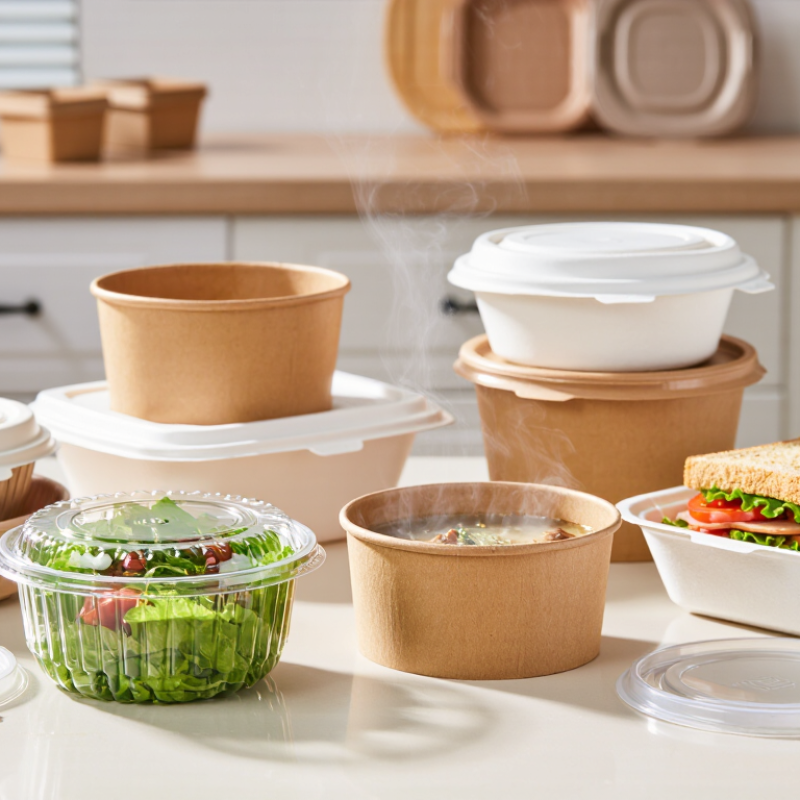
How to Choose Disposable Food Storage Containers?

Define the Intended Use and Storage Conditions

Define the job before comparing container shapes or prices. A container for a dry pastry has different needs from one holding hot soup or a chilled salad. Consider the food’s temperature, moisture, acidity, and expected storage time. For refrigerated meals, check that the container is suitable for cold storage and that its lid fits securely. For hot foods, confirm the stated temperature limits; not every disposable container is designed for hot filling. Labels matter. If reheating is planned, use only containers explicitly marked as microwave-safe, and follow their instructions.

Think about how the food will be handled, too. A shallow container can cool or chill food more evenly than a deep, tightly packed one, while a leak-resistant lid matters in a lunch bag or delivery box. Leave room for liquids to shift during transport. I may be overcautious, but a slightly loose lid can turn a neat meal into a cleanup. Check whether the material suits oily or acidic foods, since some may stain or soften. Match the container to the actual task, not an imagined one. A brief storage test with water can reveal a poor seal, though it cannot confirm food safety or heat tolerance.

Compare Container Materials and Food-Safety Properties

How to Choose Disposable Food Storage Containers?
Compare Container Materials and Food-Safety Properties

A container’s material affects more than its price. It influences heat tolerance, leak resistance, and which foods it suits. Polypropylene (PP) containers are often used for warm meals, but check the label before microwaving. “Microwave-safe” applies to the container’s stated use, not every heating condition. Check the label.

PET containers are commonly chosen for chilled salads, fruit, and takeaway portions. They are clear and lightweight, but generally aren’t designed for reheating. Paper-based containers can work well for dry or greasy foods, yet their inner coating matters when holding liquids. Aluminum trays handle oven heat when specifically rated for it, but shouldn’t go in a microwave. The detail is easy to miss. A familiar-looking container can give a false sense of safety.

Tips: Match the container to the food’s temperature and moisture. Look for food-contact and heating instructions, and inspect for cracks, warped edges, or peeling. Don’t reuse a disposable container if it has softened; cleaning may not restore its original condition. When practical, let very hot food cool briefly before sealing it to limit trapped steam. Verify labels rather than relying on appearance alone.

Select the Right Size, Shape, and Closure

Choose a container by the food it must hold, not just by its listed capacity. A shallow, wide shape cools leftovers faster than a deep tub and makes rice, roasted vegetables, or sliced fruit easier to portion. Leave a little headspace for foods that may shift in transit. For soup or sauce, choose a leak-resistant closure and test it upright before stacking. A tight lid matters. But it cannot fix an overfilled container.

Tips: Match the container to one meal or serving. Check that corners and rims are not warped, then press around the full lid edge. If containers will be stacked, test the actual filled stack; a neat empty stack can be misleading.

Closure choice also affects food handling. The USDA recommends refrigerating perishable leftovers within two hours and using most cooked leftovers within three to four days. Choose containers that seal reliably and fit your refrigerator shelf, so food can be stored promptly. The U.S. Environmental Protection Agency reported that food made up 24.1% of municipal solid waste sent to landfills in 2018. That figure is not a measure of container performance, but it is a useful reminder to size portions realistically and avoid storing more than you can use. A small mismatch still happens. Recheck your usual portions after a week.

Check Temperature Limits and Disposal Options

Disposable food containers can look alike, yet their temperature limits may differ. Read the base or sleeve for stated ranges and microwave or freezer instructions. A container meant for cold storage may soften when filled with steaming soup. Labels are not decoration.

For reheating, use only containers explicitly marked for microwave use, and follow any time limits. Keep them away from stovetops and broilers unless the instructions say they can handle that heat. If the label is missing, transfer food to a dish known to be heat-safe. It is tempting to assume a thicker container tolerates more heat, but appearance is not a dependable test.

Disposal needs attention, too. Check the material details against your local recycling program; accepted items vary by area. Empty the container and scrape off food residue where practical, since leftovers can complicate sorting. “Compostable” does not always mean suitable for a backyard bin; some products need commercial processing. When guidance is unclear, follow local waste instructions rather than guessing.

Evaluate Cost, Durability, and Supplier Requirements

A low unit price can hide the real cost of disposable food storage containers. Compare the delivered price, including lids, freight, and expected waste from damaged units. A container that costs slightly more may save money if it stacks neatly and arrives intact. Still, estimates can be wrong. Check actual packing and storage conditions before committing to a large order.

Durability should match the food and service routine. Fill samples with soup, chill them overnight, and carry them in a typical delivery bag. Watch for leaks, warped bases, loose lids, and containers that buckle when stacked. Test them. A container may perform well with cold salad but struggle with warm, oily food. Record what happens, even if the results are uneven; one quick test rarely tells the whole story.

Supplier requirements matter just as much as the container itself. Ask for clear material specifications, food-contact documentation, sample availability, minimum order quantities, and realistic production lead times. Confirm that repeat orders will match the sample in size, lid fit, and packaging. These questions take time. A small supplier may offer flexibility but have limited capacity, while a larger one may require longer commitments. Request written answers and check them against your forecast before placing an order.

How to Choose Disposable Food Storage Containers? - Evaluate Cost, Durability, and Supplier Requirements

Comparison guide for common disposable container materials. Cost figures are indicative bulk-purchase estimates per container for standard sizes at approximately 10,000 units or more; actual quotations depend on size, design, order volume, and location.

Material Indicative Unit Cost (USD) Durability and Leak Resistance Typical Temperature Considerations Common Uses Supplier Requirements to Verify
Polypropylene (PP) $0.04–$0.18 Lightweight and generally resistant to impact. Lids can provide a secure fit when matched to the container; leak resistance depends on the design. Some products are suitable for reheating, but microwave use and temperature limits must be confirmed on the specific product. Not intended for oven use unless explicitly specified. Takeout meals, meal prep, cold foods, and some reheatable portions. Request food-contact compliance documentation for the intended market, temperature-use specifications, lid-fit testing, and confirmation that any microwave claims apply to the exact product.
Polyethylene terephthalate (PET) $0.03–$0.15 Clear, lightweight, and reasonably rigid for cold foods. May crack or deform under heat or rough handling; snap-on lids are not necessarily leakproof. Generally used for chilled or room-temperature foods. Not suitable for microwave heating unless the supplier provides product-specific approval. Salads, fruit, bakery items, and chilled grab-and-go foods. Confirm food-contact documentation, clarity and wall-thickness specifications, lid compatibility, and any stated limits for hot filling or temperature exposure.
Expanded polystyrene (EPS) $0.03–$0.12 Very lightweight and insulating, but can crush under pressure. Hinged or separate-lid designs vary in closure security. Often used for hot or cold service, but allowable temperatures depend on the product. Avoid microwave use unless specifically approved. Hot meals, takeaway portions, and temperature-sensitive food service where local rules permit. Check local restrictions on EPS food-service packaging, food-contact compliance, insulation performance, and whether the design meets the required stacking and transport conditions.
Molded fiber or bagasse $0.08–$0.35 Rigid enough for many meals and often suitable for greasy foods when designed or treated for that use. Liquid resistance varies; extended storage of wet foods may soften the container. Many products are designed for hot foods, but microwave, oven, and temperature limits are product-specific and should be verified. Takeout meals, sides, and food-service applications seeking fiber-based packaging. Ask for food-contact documentation, performance data for oil and moisture resistance, additive or coating details, and substantiation for compostability claims in the intended disposal environment.
Paperboard with a barrier lining $0.06–$0.30 Lightweight with good stiffness for dry or moderately moist foods. Barrier performance and leak resistance depend on the lining, seams, and closure design. Hot-food capability varies by lining and construction. Microwave suitability should be confirmed for the specific container; do not assume it is oven-safe. Soups, snacks, bakery products, and takeout meals when the selected barrier matches the food. Verify lining material, food-contact compliance, hot-fill and leak-test results, sealing compatibility, and whether recycling or compostability claims apply to the finished product.
Aluminum foil container $0.08–$0.40 Good heat tolerance and generally strong resistance to grease and moisture. Can dent if thin and may require a separate lid or board cover. Many products are suitable for conventional ovens when specified by the supplier. Aluminum containers must not be used in a microwave unless the appliance and product instructions explicitly allow it. Oven-ready meals, roasting, baking, and hot food transport. Confirm food-contact compliance, gauge and dimensional tolerances, lid fit, oven-use limits, and clear microwave-use instructions for the exact container.

Purchasing note: Compare total landed cost, not unit price alone. Request samples, a written specification, food-contact documents for the destination market, test results relevant to the intended food and temperature, lead times, minimum order quantities, and packaging details. Prices are illustrative estimates, not supplier quotations.