Buying wooden maze toys in bulk is not simply a matter of finding the lowest unit price. A smooth wooden bead, snug joints, clear finish, and sturdy packaging can make the difference between a toy that survives classroom use and one that arrives with chipped corners. Maze Wooden buyers should compare samples, request material and finish details, and check how suppliers handle defects before placing a large order. Small details matter.
Market context helps, but it needs careful interpretation. Circana’s 2023 Global Toy Industry report found toy sales declined 7% worldwide from 2022, while remaining 17% above 2019 levels. These figures describe the broader toy market, not wooden maze toys specifically. Still, they suggest buyers should weigh stock risk, reorder timing, and demand rather than relying on optimistic forecasts. A low price can become costly when quality varies between cartons.
Play researcher Dr. Stuart Brown wrote, “The opposite of play is not work—the opposite of play is depression,” in Play: How It Shapes the Brain, Opens the Imagination, and Invigorates the Soul. His work underscores why play value deserves attention alongside price. For bulk buyers, that means checking whether a maze is engaging, age-appropriate, and durable in real hands—not just attractive in a catalog photo. This guide explores seven practical checks, from sample inspection and supplier questions to packaging and repeat-order planning. No checklist replaces judgment; even a good sample may not represent every production run.
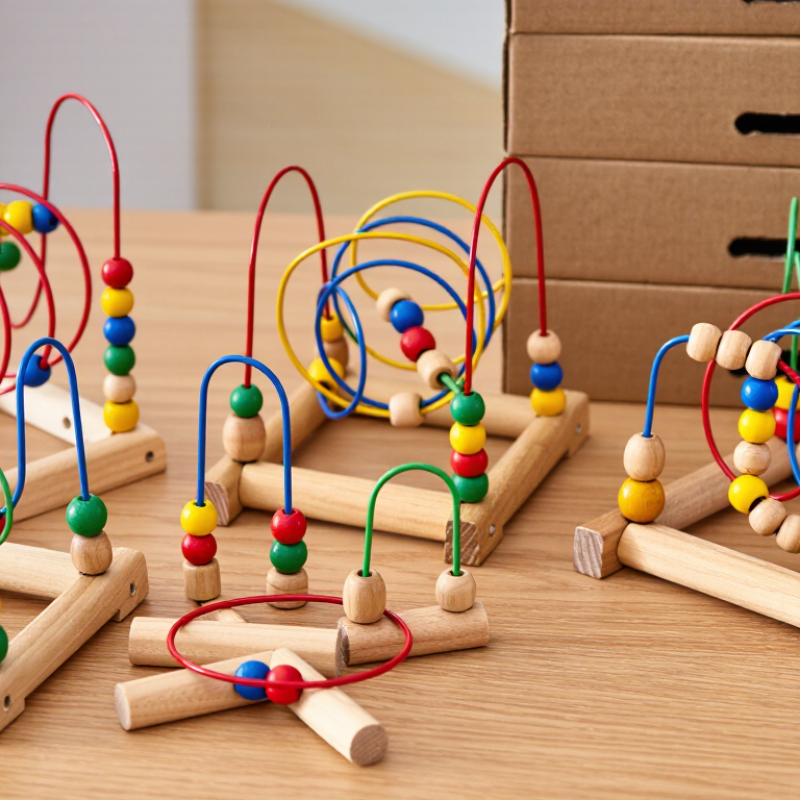
Tip 1: Define the age grade before requesting a price. A maze with large wooden beads suits a different age range from one with tiny moving pieces. The U.S. Consumer Product Safety Commission estimated 209,500 toy-related emergency-room injuries in 2022. This figure covers toys broadly, not maze toys alone, but it underlines why age suitability and safety checks belong in the brief. Confirm the intended users and applicable testing requirements with your supplier.
Tip 2: Specify the maze design in practical terms. Include board dimensions, wood finish, path width, moving-piece size, and whether the design is single-sided. A simple sketch can prevent a costly mismatch. One weak spot in many briefs is relying on a product photo; it may hide details that affect tooling and assembly. Recheck your specifications after reviewing a sample.
Tip 3: Set packaging and order volume before asking for a quote. State whether each maze needs a color box, instruction sheet, or protective insert, then request carton dimensions and units per carton. Circana reported U.S. toy sales of $28.3 billion in 2023, down 8% from 2022. Market demand can shift, so compare a trial quantity with larger-volume pricing. Small orders may carry higher per-unit costs. Don’t overlook storage space.

When buying wooden maze toys in bulk, request current FSC Chain of Custody records before approving a sample or deposit. Ask for the certificate code, its scope, and documents linking the wood claim to your order. The certificate must cover the supplier’s relevant product group and remain valid when the order is processed. Details matter. FAO’s Global Forest Resources Assessment 2020 estimated annual deforestation at 10 million hectares in 2015–2020, down from 16 million hectares in 1990–2000. That context makes traceable sourcing worth checking, not assuming.
Compare the certificate details with the invoice and product paperwork. Check that the stated FSC claim matches the order; FSC 100%, FSC Mix, and recycled claims are not interchangeable. For a large shipment, request batch-level records that connect the paperwork to the cartons you receive. Then verify the certificate in FSC’s public certificate search. Keep copies with your purchasing records. A neat certificate alone is not the whole story. Chain-of-custody records document how certified material moves through covered businesses; they do not prove every environmental outcome, toy’s safety, or the origin of each individual wooden piece. If a supplier cannot explain a mismatch, pause and ask for corrected documents. That may slow purchasing, but guessing is worse.
When buying wooden maze toys in bulk, treat lead limits as a lot-level check, not a promise printed on a supplier sheet. U.S. CPSC rules set a 100 ppm limit for total lead in accessible component parts and a 90 ppm limit for lead in paint or similar surface coatings. These are separate tests: a brightly painted bead may pass one check and fail the other. Ask for laboratory results tied to the exact wood, coating, and production lot you plan to order. A certificate for a different finish is not enough. Small details matter.
Request test reports that identify the test method, sample date, and tested components. Confirm which parts are accessible under CPSC definitions; visibility alone does not decide that. CPSC’s 2023 Toy-Related Deaths and Injuries report estimated 231,700 emergency-department visits involving toys. That figure concerns injuries generally, not lead exposure, but it shows why careful product review matters. Keep samples from incoming cartons and compare paint color, coating thickness, and maze-piece construction against the tested sample. Bulk shipments can vary. I would still want a clearer paper trail when several factories or finishes are involved. A low price is less reassuring when the report cannot be matched to the goods.
U.S. federal limits are 100 ppm for lead in accessible component parts and 90 ppm for lead in paint and surface coatings. These are regulatory limits, not test results for any specific toy.
When buying wooden maze toys in bulk, ask for the complete EN 71-3 test report, not just a one-line pass claim.
The standard assesses migration of 19 regulated elements from toy materials under defined test conditions. Review the tested parts: painted beads, printed surfaces, coatings, and exposed wood may differ. A report should identify the samples, test date, methods, results, and laboratory details. Check whether the tested sample matches the current production design and finish. Small details matter.
Compare results with the applicable limits for each material category, and note the units and detection limits. A result below a limit does not prove every production lot is identical. Ask how the supplier controls paint changes, wood sourcing, and incoming batches. Request traceability linking the report to the goods you will receive.
For a large order, consider independent sampling from pre-shipment units, especially when colors or coatings vary. It takes time. Still, a tidy PDF can leave gaps: confirm the report’s scope with the testing laboratory when descriptions are vague, and keep the records with your purchase specifications. This check is useful, but it does not replace reviewing other relevant toy safety requirements.
Before bulk production, approve a signed reference sample with maze dimensions, bead travel, finish, and packaging recorded. Photograph the sample beside a ruler. ISO 2859-1 provides attribute-sampling plans using lot size, inspection level, and an agreed AQL. Set these before production, not after defects appear. For wooden maze toys, inspect for splinters, loose parts, rough edges, and coating defects. Define critical, major, and minor defects separately. AQL is a sampling decision, not permission to ship unsafe products.
Ask the supplier to quote inspection costs, rework terms, and replacement costs alongside unit pricing. For each lot, specify random carton selection and document the sample size, defect counts, and accept-or-reject result. The U.S. CPSC’s 2023 Toy-Related Deaths and Injuries report estimated 231,700 toy-related emergency-department-treated injuries; this figure covers toys broadly, not wooden mazes alone. It is a useful reminder to treat checks seriously. Sampling still misses defects. Keep that limitation visible, and use separate safety checks where needed. A tidy report cannot fix a weak inspection plan.